
 54 Hope St, Brunswick VIC 3056
 0406 154 886
 Email Us
You have a SCOBY in a bag on the bench, a big glass jar, and a rough memory of someone saying it is just tea and sugar. Then you look it up. One guide says cups, another says gallons, a third says three weeks. None of them were written for a kitchen that hits 38 degrees in February and 14 degrees in July.
Making kombucha at home comes down to four things: sweet tea, a SCOBY, starter liquid and time. The basic kombucha recipe is 1 litre of water, 50 grams of raw sugar, 5 grams of green or oolong tea, and about 200ml of starter liquid. Cover the jar with a breathable cloth, keep it between 23 and 29 degrees, and leave it 7 to 10 days. It is ready when it tastes lightly tart instead of sweet, with a pH below 4.5.
Two terms worth clearing up first. A SCOBY is a symbiotic colony of bacteria and yeast, the rubbery disc that turns sweet tea into kombucha. Starter liquid is plain, unflavoured kombucha from an earlier batch, and it usually arrives in the bag with the SCOBY when you buy one. The first ferment is the stage covered here. The second ferment is the sealed-bottle stage that adds fizz and flavour afterwards.
Download our BREW BIBLE Kombucha brewing instructions
Recipe
The kombucha recipe by batch size
Everything scales in a straight line. The ratio is 50 grams of sugar and 5 grams of tea for every litre of water, with starter liquid at roughly a fifth of the batch volume.
| Batch Size | Water | Raw Sugar | Green or Oolong Tea | Starter Liquid |
|---|---|---|---|---|
| 1 litre | 1 litre | 50g | 5g | 200ml (approx.) |
| 5 litres | 5 litres | 250g | 25g | 1 litre (approx.) |
| 10 litres | 10 litres | 500g | 50g | 2 litres (approx.) |
| 20 litres | 20 litres | 1kg | 100g | 4 litres (approx.) |
Leave at least 5cm of clear space at the top of the jar so the culture can breathe and the liquid can move. A 220ml SCOBY pack is sized to start a 1 litre batch. Once it has grown you can scale up, but go in steps. Jumping straight from 1 litre to 4 leaves the culture badly outnumbered by fresh sweet tea, and that is when batches stall.
Equipment
What do you need to make kombucha?
Five things, and most of them are already in the kitchen.
A SCOBY and Starter Liquid
Buy them together. A SCOBY without starter liquid has nothing acidic to protect the first few days.
A Breathable Cover
A tea towel or square of cotton and a rubber band. Not a lid. The ferment needs air, and a sealed jar builds pressure.
Plain Tea
Green oolong or black all work. Avoid flavoured blends like Earl Grey, because the oils in them build up and weaken the culture over repeated batches.
Raw or White Sugar
The culture eats the sugar, so very little is left by the end. Honey, maple syrup and stevia do not work here. Honey feeds jun, which uses a different culture.
A Jar of Glass, Ceramic or Food Grade Plastic
No metal and no crystal. Kombucha is acidic and will pull material out of both.
Two extras earn their place quickly: pH strips, so readiness is a reading rather than a guess, and a cheap stick-on aquarium thermometer for the side of the jar. Room temperature and jar temperature are not always the same number.
Method
How to make kombucha, step by step
The whole active part takes about twenty minutes. The rest is waiting.
The SCOBY may float, sink or sit on an angle. All three are normal and none of them tell you anything about how the batch is going.
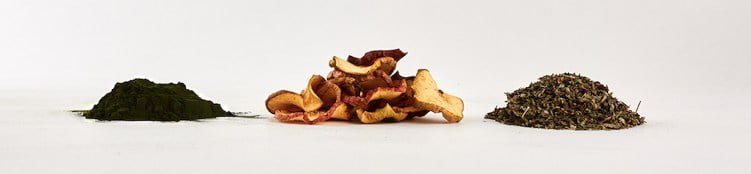
EVERYTHING IN ONE BOX
Fermenter, SCOBY, tea and sugar, ready to brew your first litre.
Timing
How long does kombucha take to ferment?
| Room Temperature | First Ferment Takes | What to Watch For |
|---|---|---|
| Above 29°C | 4 to 6 days | Taste from day 4 or it turns sharp. |
| 23 to 29°C | 7 to 10 days | The range to aim for. Taste from day 7. |
| 18 to 22°C | 10 to 16 days | Slower. Keep the starter at full strength. |
| Below 18°C | 2 to 3 weeks or stalls | Mould risk climbs. Move it somewhere warmer. |
Readiness
How do you know when it is ready?
Taste is the deciding test and pH is the safety check. Slide a clean straw down the side of the jar, past the SCOBY, cover the top with a finger and lift out a small sample.
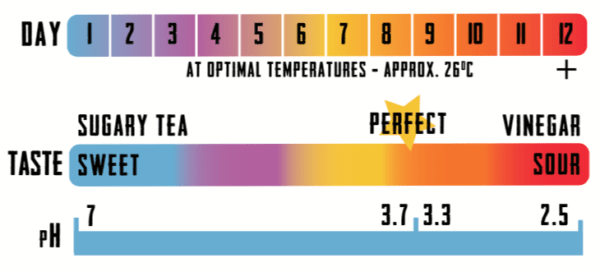
Taste
lightly tart, with the syrupy sweetness gone. If it still tastes like sweet tea, give it more days. If it makes you wince, it has gone past drinking and is on its way to vinegar.
pH
below 4.5 is the line to hold. Most finished first ferments land between 2.5 and 3.5. Anything sitting above 4.5 has not acidified enough to be safe and needs longer or a fresh start.
Fizz
a fine ring of bubbles around the edge of the surface means the culture is active. Big fizz comes later, in the sealed bottle stage, not here.
One thing that is not a readiness signal: the new pale layer forming across the surface. That is a fresh pellicle, the cellulose mat the culture builds. It confirms fermentation is happening. It says nothing about whether the batch is finished, and a batch with no visible new pellicle can still be perfectly good.
Download our BREW BIBLE Kombucha brewing instructions
Readiness
What goes wrong, and what to do
Three problems account for most first-batch failures.
Nothing has happened by day ten. Almost always temperature, or a SCOBY that went into cold tea. Move the jar somewhere warmer and give it another week before writing it off. A stalled ferment smells bready and sweet. A healthy one smells sharp and cidery, a bit like a cut apple left out.
Dry, fuzzy patches sitting on top of the surface. That is mould, and it is usually blue, green or black. Throw out the whole batch including the SCOBY and the liquid. Do not try to scrape it off.
Brown stringy strands hanging underneath the SCOBY. That is yeast, and it is meant to be there. Strain it out at bottling if the texture bothers you.
The rule of thumb worth remembering: mould is dry and sits above the liquid, yeast is wet and hangs below it.
FAQ
Questions people ask about making kombucha
Can you make kombucha without a SCOBY?
You can grow one from a bottle of raw, unpasteurised kombucha left with sweet tea for two to four weeks. It works, but it is slower and less reliable than starting with an established culture, and pasteurised supermarket kombucha will not do it.
Does homemade kombucha contain alcohol?
A small amount, produced naturally by the yeast. Home brewing typically produces more than commercial bottled kombucha because there is no control over the final stage. Long ferments and warm rooms both push it higher.
How much starter liquid do you need?
Around a fifth of the batch volume, so 200ml for a 1 litre brew. That is the one-to-five ratio, and it is the strongest mix worth using. Less than a tenth leaves the batch vulnerable to mould in the first few days, which is the more common mistake.
How long does homemade kombucha keep?
Several months in the fridge, where the cold slows fermentation almost to a stop. It keeps changing slowly, getting more sour over time, so drink it while it still tastes the way you like it.
Can you use tap water?
Yes, and most home brewers do. Chlorine can knock the culture back, so if your water tastes strongly of it, boil the water and let it stand uncovered for an hour before making the tea.
Keep it going
What to do with your second batch
By the time the first batch is ready you own more than you started with: two SCOBYs, since a new one grows on the surface every batch, and more liquid than a single brew needs. That is the point where most people stall. The kombucha gets drunk, the SCOBY sits in a jar on the bench, and six weeks later nobody is sure whether it is still alive.
The fix is to have the next batch ready before the first one finishes. Around day five, brew the sweet tea for batch two and let it cool. When you bottle the first batch, hold back 200ml as starter, pour the new tea straight in, and the cycle never breaks. Expect batch two to run faster than batch one, often by a day or two, because your starter liquid is now more acidic than what came in the bag.
If the culture needs replacing, or you want a larger one to brew more than a litre at a time, Good Brew sells organic SCOBYs and complete brewing kits with the fermenter, tea and sugar included. The monthly brewing workshops in Brunswick are the faster route if you would rather taste the difference between a five day brew and a twelve day brew before you commit to a fortnight of guessing.
Download our BREW BIBLE Kombucha brewing instructions